GO
Sorry, but you already have a basket with that name. Please use something else.
Are you sure you wish to delete this basket?()
This action cannot be undone.
Sorry, something went wrong
Please report the problem here.
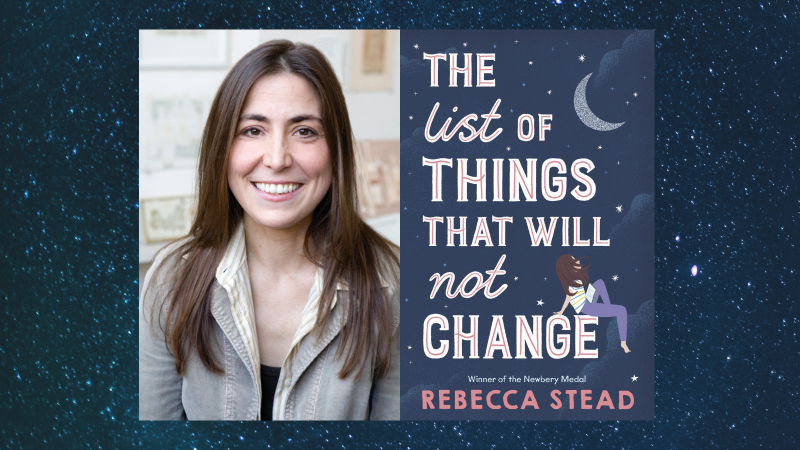
The List of Things That Will Not Change, Q&A with Rebecca Stead
April 1st 2021
Hello Rebecca!
Hello everyone! Hoping you are all doing okay these days.
Q: Can you tell us a little about your new book, The List of Things That Will Not Change?
The story is about the fifth-grade year (in American usage) of Bea, a city girl who is an only child with a pair of pretty wonderful divorced parents, a great best friend named Angus, and a dad who is planning to marry his boyfriend, Jesse, at the end of the school year.
Jesse’s daughter Sonia, who lives in California and is exactly Bea’s age, is coming to stay with them for the first time ever, and Bea, who has wanted a sister her whole life, can’t wait to finally get her hands on one. But things don’t go as smoothly as she imagines they will.
Bea’s feelings arrive mostly in size extra-large, and she feels every bump on the road. But, helped by the ones she loves and a great therapist named Miriam, she navigates this up-and-down year to a place of happiness and, importantly, self-acceptance.
Q: What was your inspiration?
My idea-generating process can be summed up as “collection” – of images, fun facts, wishes, memories, questions, and so on. Bea’s home life – divorced parents, the two-apartment arrangement – is how I grew up. Her eczema and deep longing for a sister are also semi-autobiographical. But many of the details that flesh out the world of the story – including the “list” named in the title – came from other people’s experiences. And the oyster-related inspiration showed up years ago while I was researching New York City high schools. Once I start writing, lots of small ideas float around in my head and seem to attract or repel one another, like mysterious story magnets.
Q: Which character is most like you?
Bea! We have a good deal in common without being even close to the same people. We both have divorced and loving parents, big emotions, sister-envy, eczema, straight moms and gay dads. We’re both New Yorkers. We wear our hearts on our sleeves. But she likes oysters better than I do.
Q: What do you think Bea at the end of the story would tell Bea at the beginning, if she could?
Interesting question. This is a book about feeling safe inside your life (and inside yourself). I think Bea-at-the-end-of-the-story knows that younger Bea needs to walk that road herself.
Q:What was the most fun part about writing this book?
Usually the fun is in getting small moments right, and discovering ideas that resonate (like the one-eye-open moments in this story). But in general, I really loved writing about Bea’s great friendships with Jesse, her dad’s boyfriend, and with Angus, her best friend. There’s a lot of pleasure to be found in writing relationships full of love.
Q:What was the most difficult part about writing this book?
Writing the wedding scene was the most challenging part of the experience for me. In many ways (but not every way), it’s the climax of the story. The challenge was not to overdramatize, and to discover the meaning of that day for Bea.
Q: What was your favourite book when you were growing up?
I loved different kinds of books – books about real life (including city kids and kids with divorced parents, like me) by Norma Klein and Judy Blume, books about animals (I loved James Herriot), and fantasy and science fiction books (Madeleine L’Engle’s a Wrinkle in Time, Robert Heinlein’s Red Planet, Anne McCaffrey’s Pern books, Edward Eager’s Half Magic, Ray Bradbury’s stories).
Q: What advice would you give to anyone who’s thinking about becoming a writer?
First, never stop reading. Second, don’t be afraid of the feeling that you don’t really know what you’re doing. Third, find some friends who write, even if it means extending yourself more than feels comfortable. It’s worth it.
Q: Why did you decide to write stories for young people?
I think it has to do with the way I felt about books as a young person. They were doors into other worlds, and also doors into myself.
Q: When you sit down to write, what do you need around you?
A notebook, a pencil, and a pencil sharpener. Usually coffee, because I write in the morning. And – very important – the absence of any device connected to the internet.
Q: What other jobs have you done aside from being a writer?
Fact-checker, assistant copy editor, law clerk, public defender. When I was in college, I cooked at a snack bar, which I liked a lot.
Q: What are some of your favourite things?
Coffee. Blueberries if they are tart. Walking with friends, cooking with my family. The sound of people talking in the other room.
The list of things that will not change is out in paperback on 1st April.
- hello@peters.co.uk
- 0121 666 6646
- Send a message
- Meet the team
- Peters Ltd
- 120 Bromsgrove Street
- Birmingham
- B5 6RJ