GO
Sorry, but you already have a basket with that name. Please use something else.
Are you sure you wish to delete this basket?()
This action cannot be undone.
Sorry, something went wrong
Please report the problem here.
The Bard, Baz Luhrmann and Bottoms, or How I Fell for Mr William Shakespeare
March 4th 2022
Last weekend, I made a mini-pilgrimage to a very special tree. It was beneath this tree in circa 1990 where I met the Bard for the very first time. All the kids from the neighbouring streets in my corner of South London were there, watching a free outdoor production of A Midsummer Night’s Dream. We spent most of the night alternating between gasps of wonder and fits of giggles. It didn’t matter that we were only ten and didn’t really understand the intricacies of the language being thrown about beneath this magnificent oak; we had been transported into another world, we were being entertained, and we were loving it.
Shakespeare’s work is rightly treated with reverence today, but is it to such an extent that it creates a barrier to people’s enjoyment – and particularly young people? After all, it’s full of stuff that would not be out of place in an episode of Game of Thrones… The hip-hop artist and educator Akala, founder of The Hip-Hop Shakespeare Company, is well-known for his ‘Hip-hop or Shakespeare?’ quiz, where he asks his audience – often made up of young people – to guess if he is quoting a hip-hop lyric or a line of Shakespeare. Akala’s message is far more detailed and erudite than this brief acknowledgement can indicate, but the point is to show people who may feel that this ‘Great Literature’ is for the elite only, that it’s also for THEM. After all, the majority of Shakespeare’s original audiences were not made up of the elite.
I’m the child of two primary-school teachers who was fortunate to grow up surrounded by books and as much of an exposure to the Arts as my parents could afford, but I still struggled to read or understand the Shakespeare I encountered in the classroom. I didn’t go into Year 7 with prior knowledge of what Macbeth was about, and despite having a dynamic, generous teacher, failed to be thrilled by the gore and scheming and DRAMA of the story – there are witches in it; for goodness sake, what’s not to love?! Instead, I got bogged down in the weird apostrophes in odd places in words or the unfamiliar vocab – and probably also the all-pervading sense of hushed reverence that there was at my school surrounding Shakespeare. Interestingly, I’d been gifted a ‘children’s’ illustrated version of The Canterbury Tales before going to secondary school – the bare bum in the illustration of The Miller’s Tale never failed to send me and my little brother into paroxysms of glee – and when it came to studying Chaucer’s Middle English, also in Year 7, I didn’t struggle in the same way. I’m convinced this is because I already had a route in, thanks to an understanding of story and context, and a visual language – courtesy of the illustrations in my book – around what was playing out in the somewhat unintelligible words on the page in front of me.
And then, six-or-so years after first laughing at Bottom prancing about under that tree, it was like the dry, dusty Shakespearean scales of the intervening years fell from my eyes and the true love affair with Shakespeare’s work began. All thanks to an Australian director called Baz Luhrmann. It definitely helped that I had an all-encompassing teenage crush on Leonardo DiCaprio (see my small gift to 1996-me in the book!), but Luhrmann’s neon-lit interpretation of Romeo and Juliet, with DiCaprio as Romeo, really showed how Shakespeare’s work can feel contemporary, and relevant, and heart-racingly sexy. The Montagues wore Hawaiian shirts and board shorts! The Capulets drove sports cars! Mercutio appeared at the Capulet ball in drag! Radiohead were on the soundtrack! It blew my mind. Exactly how I’d imagine audiences might have felt watching Shakespeare’s latest play all those centuries ago, it was taking work that previously felt quite remote, distanced, high-brow, and instead saying – this is who you are, what you are into, today. And for the first time, the words spoken by Luhrmann’s cast – pretty-much faithful to Shakespeare’s own – made perfect, beautiful sense.
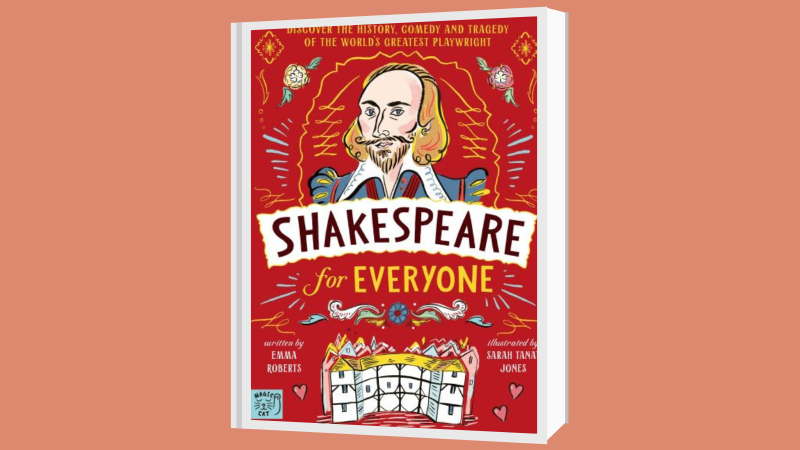
My aim with Shakespeare For Everyone is to try and bring something of that sense of relevance and ownership to readers of today, by putting the reverence to one side in favour of fun. I want to empower readers of all ages and from all backgrounds with a stash of supporting knowledge to help them find a way into the language, and, if they’re fortunate enough to see a play performed, with a framework to enhance what’s playing out in front of them – whether that’s beneath a tree in their local park or onstage at The Globe. Sarah Tanat Jones’s playful, vibrant illustrations bring such incredible energy to my words (with no bare bums, you’ll be relieved to hear), as well as that contemporary visual language that Luhrmann’s styling in Romeo + Juliet gave me all those years ago. I also want to break down barriers by showing the reader that William Shakespeare of Stratford-Upon-Avon was a real person. He was a kid, he fell in love, he lived through a pandemic (!) and he came up with some of the most hilarious insults ever known.
I’m sure there are many who would disagree, but for me, when Shakespeare is allowed to climb down from his pedestal and join us grubby, excitable Groundlings standing in the yard, it’s where we’ll love him the most.
Shakespeare for everyone is out now.
- hello@peters.co.uk
- 0121 666 6646
- Send a message
- Meet the team
- Peters Ltd
- 120 Bromsgrove Street
- Birmingham
- B5 6RJ