GO
Sorry, but you already have a basket with that name. Please use something else.
Are you sure you wish to delete this basket?()
This action cannot be undone.
Sorry, something went wrong
Please report the problem here.
Seeing Sense and the importance of visual literacy by Jake Hope
July 27th 2020
Jake Hope is a reading development and children's book consultant. He was the Reading and Learning Development Manager for Lancashire Libraries, one of the largest library authorities in the UK. Jake has judged nearly every major children's book award in the UK, including the Carnegie and Kate Greenaway Awards, and has chaired numerous promotional selection panels. Alongside delivering training and public speaking on books and reading, Jake is an active reviewer and a passionate advocate for libraries books and reading. We caught up with him to talk about his new book Seeing Sense, which showcases the role of visual literacy as a tool for promoting reading.
Quentin Blake’s Patrick was one of my favourite books as a child. I remember pleading to be allowed to borrow it one more time from the library! Reading it again today, it is easy to see why it made such an impact. There’s a remarkable energy in the line, huge explosions of colour and there is something deliciously irresistible about trees dripping in buttered toast.
Illustrations are key in helping to cement our early memories of books and reading and often then play a huge role in scaffolding, the first steps on the journey towards learning to read. Curiously, however, as people’s confidence and skills develop in reading the written word, too often there seems a waning in confidence around visual literacy.
This dichotomy between the lifelong memories that illustrations often provide and the uncertainty around how to articulate what we see in illustration feels odd. It was something I felt acutely aware of when working for Lancashire County Council’s Library Service as their Reading and Learning Development Manager and planning a yearlong promotion around visual literacy.
The plans were big… a large-scale promotion of picture books in each of the county’s main libraries, ordered from the excellent selection at Peters, Around the World in 80 Picture Books. The collections were chosen to highlight creators and stories from and about other countries and cultures around the world trying to stop off multiple times in every continent! Working with the access manager we arranged to create a portfolio of specially commissioned photographs for a large-scale community photographic exhibition to draw attention to the wealth of people and stories for Black History Month. Working with the children and young people’s manager, Jean Wolstenholme, we spearheaded the development of a new reading scheme, working with illustrator Mei Matsuoka to create this. This became The Lancashire Reading Trail and is still in use across the county today. Alongside that we also worked with Lancaster Litfest to advise on the creation of The Sea Swallow an impressive picture book commission with associated programmes of cultural and education activity which would later see enormous art installations placed along the Wyre Coastline as part of the regeneration of the sea defences.
Alongside these large-scale activities, there were numerous author and illustrator visits and local library promotions involving picture books, illustrated fiction and information books, graphic novels, Manga and television and film adaptations. Activities were also planned as part of The Big Draw tied to Anthony Browne’s (then children’s laureate) Shape Game. Using a simplified shape of the county of Lancashire we encouraged people to let their imagination and drawing skills loose and create their own pictures. We even had a number of illustrators take part including Curtis Jobling, Petr Horacek and Ross Collins.
What struck me throughout was how much pleasure, joy and play there was to be had through the subject and just how many access points and hooks this provided even for people who might not readily consider themselves readers. Imagery and signs and symbols carry an increasing weight of significance in our everyday lives. They are able to communicate meaning across both geographic and linguistic barriers and are used as the navigation base for almost every digital device.
To be able to find our way through the various forms and media through which information and stories are conveyed, it feels crucial that all involved with the promotion of reading are equipped with an awareness and recognition of the importance of visual literacy. It can be so much more than just as a crutch towards learning how to read text. It can convey sophisticated detail through infographics. It can form a part of imaginative play with books like Jason Shiga’s brilliant interactive graphic novel Meanwhile which encourages a choose-your-own-adventure style narrative based on whether the reader chooses chocolate or vanilla ice-cream, it can act as a catalyst and stimuli for young people’s own creativity!
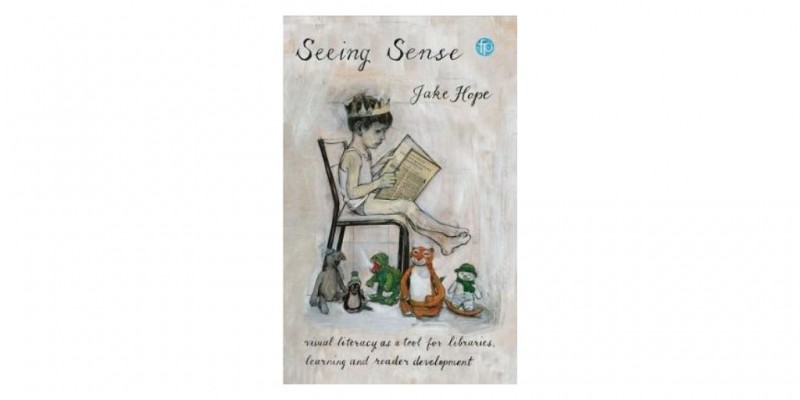
All of this became the starting point for Seeing Sense, a book about visual literacy and illustration and the roles these can play in children’s reading and learning development. One of the early decisions I made when working on the book was to try to showcase the experiences and expertise of a wide-range of creators – authors, illustrators and reading practitioners. It was massively exciting having luminaries like Philip Pullman, Shirley Hughes and Nick Sharratt contribute to the book and there was something personally very meaningful and satisfying when Quentin Blake agreed to contribute. After all, that is where my own reading journey began!
Seeing Sense published this July with Facet Publishing. It features a foreword by Philip Pullman, an illustrated foreword by Chris Riddell and an afterword by Nick Sharratt. The cover illustration is by Kate Greenaway shortlisted illustrator, Olivia Lomenech Gill.
- hello@peters.co.uk
- 0121 666 6646
- Send a message
- Meet the team
- Peters Ltd
- 120 Bromsgrove Street
- Birmingham
- B5 6RJ