GO
Sorry, but you already have a basket with that name. Please use something else.
Are you sure you wish to delete this basket?()
This action cannot be undone.
Sorry, something went wrong
Please report the problem here.
Reading for pleasure in secondary schools
October 6th 2018
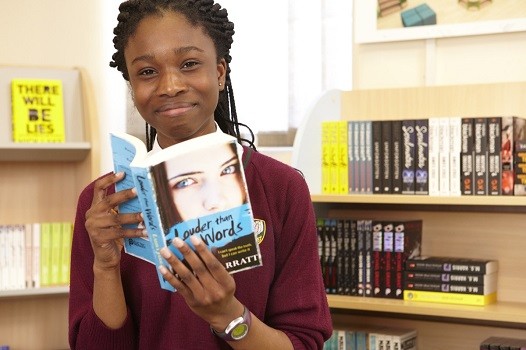
This Libraries Week, the SLA's Alison Tarrant shares her ideas for inspiring secondary school students to read for pleasure.
The range of benefits that stem from reading for pleasure are widely known, but it is the fact that they are “reciprocal and exponential” that strikes me time and time again. It is something that not only has initial benefits, but benefits that grow and expand the more its done – it’s incredible, and should be a focus of every school library.
However, there are many different barriers to reading, as there are to all activities. You can’t cycle if you don’t have a bike, and so the provision of reading materials is the primary requirement. I say reading materials, not books, because this tends to conjure a narrow image, whereas reading for pleasure should be inclusive. It’s about reading for fun, out of choice – not reading the ‘right’ thing. Reading materials includes books, e-books, audio books, newspapers, comics, magazines, and much more.
But put me in a library of engineering books and I probably wouldn’t read for fun either. I might try one or two, but engineering is not a subject I’d call a forte, and I’d probably stop after a few tries. The collection of reading material should be matched to your readers – what they like, what they need, and what they should have access to. Hopefully by tempting them in with what they like, after time they will stumble across something that they need - and also like! Make sure your resources reflect the community they serve – it shouldn't re-enforce a narrow world view, but there should be resources available that mirror their reality.
Many students I have worked with didn’t see themselves in books, and this affected their attitude – they felt that books were removed from them and reality – books were something someone else did. They felt no ownership. Involve them in the library – buy books they suggest and work with them. In my experience once they realise you’re not going to give up they become slightly more likely to work with you. Make sure your collection is diverse – in all ways: racially, ability, working class: the list goes on.
However, there may be other barriers. New research from cognitive science suggests that the working memory can actually only hold 3-5 bits of information – not the 5-7 it was thought to be. This could have a sizeable impact on someone learning to read, and if the topic or story they are reading about doesn’t resonate, then what they are reading is less likely to be absorbed into the long-term memory. Cultural influences can be huge – whether from family, TV, peers or other community groups. Work within these: is a community group holding an event? Is there a way you can build that into a library display or time limited collection? Talk to the pupils – not just about books, but about anything. Start building little bridges. Children (and all of us) are more likely to take notice of people we respect so creating professional relationships is really important to making accurate reading recommendations.
Prior knowledge is an important factor too. Take the previous engineering analogy – give me a PhD level book and I might be able to read the words, but the comprehension would not be there – not without gargantuan effort and regular internet searches. This would make it less fun unless I was really invested. I once gave a pupil a book set in London – I expected him to love it, but he didn’t. He didn’t understand what ‘the Tube’ meant so he couldn’t picture it, couldn’t place the action. And this is similar with genres as well – it’ll take a while to clarify the expectations of each genre, and the regular habits. So children might find reading a new genre unsettling at first.
Or it’s genuinely just an ‘attitude problem’ – “er, what’s the point miss?” – take the time to explain why reading is important – the high reading age of the new GCSEs; benefits to Maths, spelling and across the curriculum. ‘Exercise for the mind’. Earning more money as an adult. The list goes on (and can be found on the SLA website).
Of course, it might be the other way round – they might not have a positive attitude towards reading because they can’t access the text, but they can comprehend – which is why providing a range of formats is so important. A pupil might develop a hugely positive attitude towards reading through audio books or graphic novels, or wordless stories. Obviously we need to make sure that all pupils are literate, but it should be alongside reading for pleasure – not instead of. I know it’s an easy thing to do, but taking low ability pupils out of library lessons where they read for pleasure should be avoided – it’s potentially replacing the pleasure with something that is going to reinforce and strengthen negative feelings. All students should be able to discover the fun in reading, as then they are more likely to struggle through and want to get better.
Whatever is stopping your pupils reading it’s your job to know about it. Have those discussions, do attitude to reading surveys, find out what their reading age is and whether they have any other factors that would impact their attitude to reading, then work around it. Get them to read the first chapter, read them a bit, describe the books to them in six words. I always used to give a choice of 3-5 books, get pupils to read a first chapter and talk to me about it. It helped me make my recommendations more accurate and got them used to being able to justify an opinion. If they didn’t like any of them – as long as they could tell me why – I’d get another 3-5 and start again. Reading for pleasure is about more than just reading. It’s about sharing a passion that is going to help them fully participate in society.
Alison Tarrant is CEO of the School Libraries Association (SLA) and Chair of the Great School Libraries campaign working group.
Find out more about the SLA and the Great School Libraries campaign on the SLA website.
- hello@peters.co.uk
- 0121 666 6646
- Send a message
- Meet the team
- Peters Ltd
- 120 Bromsgrove Street
- Birmingham
- B5 6RJ