GO
Sorry, but you already have a basket with that name. Please use something else.
Are you sure you wish to delete this basket?()
This action cannot be undone.
Sorry, something went wrong
Please report the problem here.
Hope Jones Will Not Eat Meat - Q&A with Josh Lacey
January 28th 2021
Q: Can you tell us a bit about your new books, Hope Jones Saves the World and Hope Jones Will Not Eat Meat?
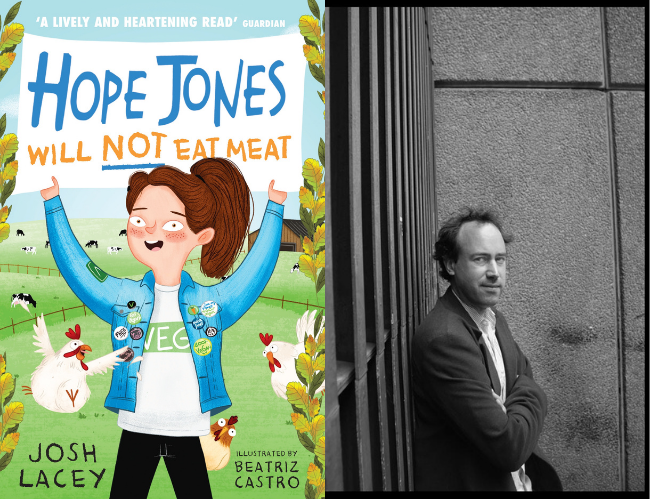
Hope Jones is a ten year old girl who is worried about climate change, so her New Year’s Resolution is giving up plastic. Quickly she finds herself in conflict with her family, her school, and the boss of the local supermarket. That’s the story of Hope Jones Saves the World, which describes Hope’s efforts to stop using plastic herself and to persuade the supermarket to use less plastic packaging. In the second book in the series, Hope Jones Will Not Eat Meat, Hope learns about the environmental impact of industrialised farming. She becomes a vegetarian, then a vegan, and ends up as a flexitarian, taking greater care about what she eats and where her food comes from.
Q: What inspired you to write about environmental themes for this age group?
I was inspired by my daughters, who are interested in climate change, and wanted to know about the changes that we could make to our own lives. I didn’t want to write a non-fiction book: there are lots already – and they’re great – but I wanted to write a novel: a story that could be funny and entertaining, but also educational and full of interesting information.
Q: These stories are told through the main character’s blog posts. Why did you decide to write the books in this way?
Writing a blog allowed me to write in Hope’s own voice. She’s a passionate, energetic ten year old, full of optimism and enthusiasm, who is determined to do something about climate change. I wish I was more like Hope. Actually, both my daughters are rather like her, and I think a lot of her character comes directly from them.
Q: What research did you have to do in order to write these stories?
I read a lot of books and articles about climate change and the environment, most of which were very depressing. I cheered myself up by learning about people who are devoting their time and energy to changing the world.
Q: What was the most enjoyable part about writing these books?
Putting aside my own worries and anxieties, and inhabiting Hope’s voice instead – she’s so optimistic and cheerful! Writing in her voice immediately makes me feel more hopeful about the future.
Q: These books are packed with amazing illustrations by Beatriz Castro – what is it like to have an illustrator bring your characters to life visually?
It’s wonderful! And very exciting. Beatriz brings her own creativity to the project, taking my characters and ideas, and transforming them with her vision. I love receiving her sketches and seeing what she has done.
Q: What do you hope readers will take from reading about Hope Jones’ activism?
If we’re really going to save the world, change must come from governments and multinational companies, rather than ordinary citizens. But that doesn’t mean that there’s nothing we can do. Through her protests, Hope discovers that she has the power to make a difference to her family, her neighbourhood, and beyond. I hope readers will take away a simple message: everyone can make a difference, whether by recycling a few cans or standing outside your local supermarket with a homemade banner, asking the managers and the bosses to change their policies.
Q: What’s next for Hope Jones? Can you give us a sneak peek of what to expect in the next book?
The third Hope Jones book, Hope Jones Clears the Air, is about air pollution – a particularly vital environmental issue for anyone who lives in a city. Transport emissions are a major contributor to climate change, of course, but at the same time, around the world, air pollution causes millions of deaths every year, and is directly linked to cancer, lung disease, dementia, and many other serious problems. Hope boycotts cars, persuades her parents to walk or ride bikes rather than driving, and asks her school to ban cars from neighbouring streets. She is also inspired by a trip to Amsterdam – and that city’s passion for bikes.
Q: And finally, what was your favourite book when you were growing up? And is there a recent children’s book, apart from your own, that you think everyone should be reading?
When I was growing up, I loved many books, but none more than a book named SOS Bobomobile by Jan Wahl, an American writer. It’s a funny, strange story about a boy who builds a machine to search for the Loch Ness Monster. Wahl was the author of a hundred picture books, and he writes with extraordinary wit and economy. As for recent books, I particularly enjoyed The Murderer’s Ape by Jakob Wegelius, a Swedish novel about a very unusual gorilla and her travels around the globe.
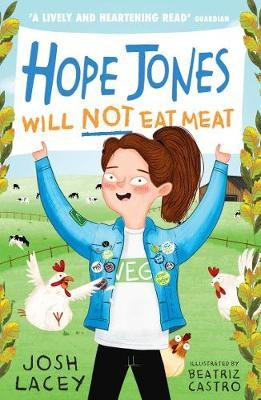
Hope Jones Will Not Eat Meat is out now.
Published by @AndersenPress
- hello@peters.co.uk
- 0121 666 6646
- Send a message
- Meet the team
- Peters Ltd
- 120 Bromsgrove Street
- Birmingham
- B5 6RJ