GO
Sorry, but you already have a basket with that name. Please use something else.
Are you sure you wish to delete this basket?()
This action cannot be undone.
Sorry, something went wrong
Please report the problem here.
Phonics and the new Ofsted framework – your questions answered
January 20th 2020
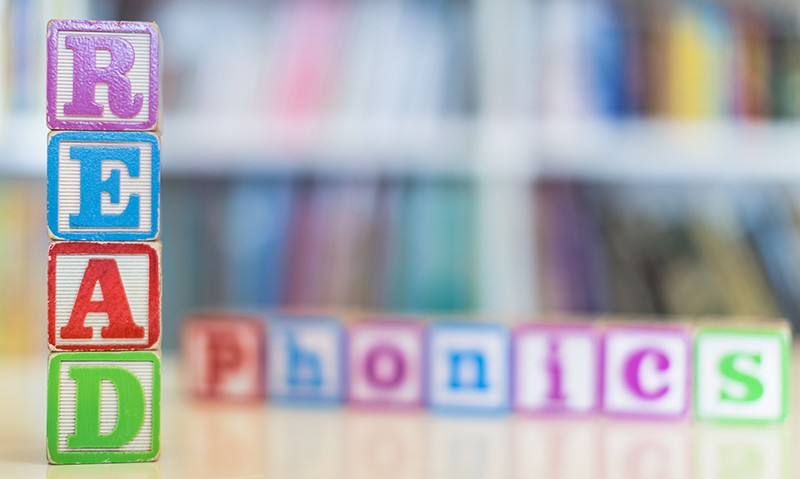
Under the new Ofsted framework, how pupils are taught to read is being prioritised as a key inspection activity in primary schools. Phonics teaching plays a key part, but so does reading for pleasure. Peters’ curriculum specialists take a look at the requirements in more detail.
What are the expectations for primary schools under the new Ofsted framework?
Phonics teaching plays a crucial part in ensuring that children are equipped with the skills they need to access the curriculum as a whole, and schools are expected to have a ‘sharp focus’ on making sure that children have ‘sufficient phonics knowledge, language comprehension and communication skills.’
What is synthetic phonics?
Synthetic phonics is the most widely used approach to phonics teaching, and schools are now required to show they are using this approach. Children are taught to read letters or groups of letters (graphemes) by saying the sound(s) (or phonemes) they represent e.g. taking a single-syllable word such as cat apart into its three letters, pronouncing a phoneme for each letter in turn – /k, æ, t/. Pupils start to read words by blending (synthesising) the sounds together to make a word.
Initially, children are taught a small group of sounds and how to blend them. Books provide consolidation as they progress through the Letters and Sounds phases.
What are the six Letters and Sounds phases?
Letters and sounds split phonics teaching into six phases, from starting to learn sounds at nursery to becoming fluent readers around aged 7.
- Phase 1 – developing speaking and listening skills to lay the foundations for Phase 2
- Phase 2 – letters and their sounds are introduced one at a time, with a new set of letters taught each week
- Phase 3 – children should already be able to blend and segment words containing the 19 letters introduced at Phase 2, and Phase 3 introduces 25 new graphemes
- Phase 4 – children should be able to blend phonemes to read CVC words, and segment to spell them. This phase consolidates pupils’ existing knowledge and some ‘tricky words’ are introduced e.g. said, have, like
- Phase 5 – those entering Phase 5 will be able to read and spell words with adjacent consonants, and more graphemes and phonemes are introduced, as well as alternative pronunciations
- Phase 6 – by now children will have learnt the most frequently occurring grapheme-phoneme correspondences, and will be able to read many familiar words automatically. When they come across unfamiliar words, they should be able to decode them confidently. The main aim of this phase is for children to become more fluent readers and more accurate spellers.
What’s the difference between books that are ‘fully decodable’ and support material that’s 95% decodable, for example?
Some books will have a high percentage of decodable words but will also introduce ‘tricky’ words (and therefore cannot be 100% decodable). Tricky words are introduced alongside picture clues to help pupils.
These books can be used as support material once children are confident with the grapheme-phoneme correspondences introduced in Phases 1–3, and ideally can be used as home readers.
Very few books are 100% decodable, particularly at the lowest levels.
Should I be using a single scheme to ensure progress, or can I use books from a range of publisher schemes?
Ideally schools might use a range of schemes to ensure pupils get enough practice and repetition at each phase. At Phases 1 and 2 in particular, there are fewer fully decodable books available, so ideally schools should have a couple of schemes so that the children have enough books at the right level.
When should I introduce decodable books, and is there a certain order in which they should be read?
Ideally, schools should introduce books once all relevant sounds have been covered in class, and pupils are confident.
How do I introduce different genres and text types?
Schemes such as Reading Planet Rocket Phonics and Big Cat Letters and Sounds provide information about the genre on the back of each book and lay the groundwork for the curriculum with a wide range of text types. Examples include instructional fiction, recounts, and poetry and plays at the higher levels. Texts will also vary between first person and third person accounts.
Along with the systematic teaching, I also want to inspire a love of reading in my pupils. What’s the best way to integrate reading for pleasure with schemed books?
Reading aloud to pupils is vitally important in inspiring a love of reading amongst your pupils. Schools should be reading a wide range of texts aloud in the classroom, including stories, poems, rhymes and non-fiction to nurture a love of reading. For the youngest pupils, ‘book talk’ is key – where pictures are used as clues to help children decipher a story as you are reading it. This starts to provide them with the vocabulary they need even if they cannot yet read and decode the words for themselves.
Make sure children have books that interest them to take home for wider reading, and that these books are at the right book band level for them.
Are there resources available for intervention at Key Stage 2 and above?
There are a number of series available for upper Key Stage 1 and Key Stage 2. Collins Big Cat Phonics Progress is aimed at boosting progress in Year 2, for those children who fail the Year 1 Phonics screening test. Read Write Inc Fresh Start is ideal for older struggling readers, or for EAL children coming in at later year groups. Ransom's Reading Stars, Reading Stars Plus and the Goal series are aimed at Key Stage 2 & 3 pupils.
- hello@peters.co.uk
- 0121 666 6646
- Send a message
- Meet the team
- Peters Ltd
- 120 Bromsgrove Street
- Birmingham
- B5 6RJ