GO
Sorry, but you already have a basket with that name. Please use something else.
Are you sure you wish to delete this basket?()
This action cannot be undone.
Sorry, something went wrong
Please report the problem here.
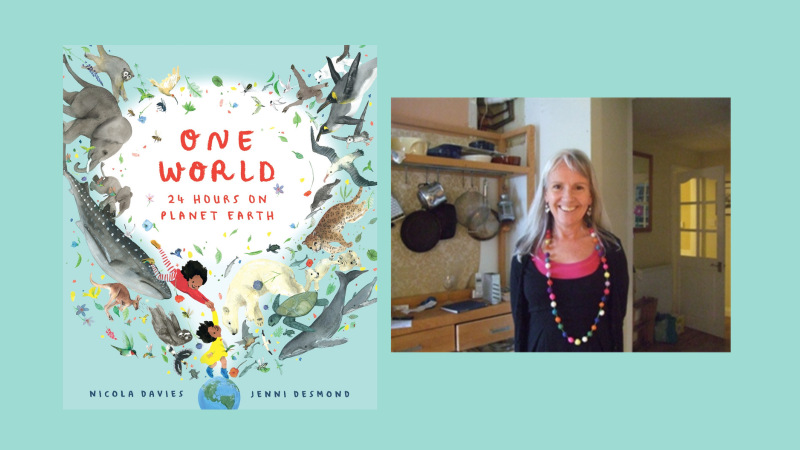
The process behind creating One World: 24 Hours on Planet Earth
April 19th 2022
Of all the sorts of writing I do – poetry, fiction, picture books – constructing a non-fiction picture book is the most difficult. It’s like doing yoga for your brain. And writing One World proved to be a bit like performing the “one-handed peacock” (google it … it’s mad!).
The basic idea came from my life-long love of globes and maps. I’ve always loved looking at a globe and imagining what is going on at a randomly picked spot. It cheers me up to think that right now down there in the Antarctic, albatrosses are riding the gales, or a herd of giraffe is galloping across the Serengeti. Of course, the darker side of that imagining is that right now on Earth incredibly diverse rainforests are being cut down to plant palm oil, and coral reefs are being smothered by agricultural run-off!
For One World I wanted to combine those two ideas: the sense of wonder at all our planet contains and the very real threats that those wonders face because of what we humans have been getting up to for the last few hundred years.
I remember as a schoolchild going to visit the Greenwich meridian and standing on that line of longitude, the zero degrees from which all the other ones run. The time it takes for the Earth to rotate through 15 degrees is what we call an hour, dividing the Earth into 24 segments, like a celestial chocolate orange. I loved the idea that, over a 24-hour period, every moment of each day exists, at once, somewhere on Earth.
So I imagined two children taking a magical journey, on the stroke of midnight, to visit every other hour around the globe, to sample the wonders of nature and witness the threats faced in each time zone. I chose London at midnight as the starting point, partly because of the meridian but also because of the symbolism of the clock striking and the sense of time running out to save the planet. Of course there weren’t enough pages to go to every time zone, so in the book we progress in slightly irregular jumps.
There were tricky decisions to be made. Some lines of longitude go through all sorts of interesting places, and some go through open ocean. So for some lines I had to choose between interesting and important stories while for others I was struggling to find something strong enough to include. I had to decide what time of year we would make our journey so that each line of longitude would run through the most interesting stories. Quite by chance, it turned out that April is the month when the most interesting things are happening in the most places, so I decided our round-the-world-trip in 12 bongs would take place as 21 April turns into 22 April: Earth Day.
It took a great deal of research. I found a lovely website where you could look up sunrise and sunset times for any point on Earth. I checked and double-checked locations, species and timing of seasonal behaviour. As a result, the locations and species changed multiple times, until finally we had a range of species and behaviours in the right places, times and seasons.
But I hadn’t bargained for the political aspect of time. Some big countries – China, for example – designate their country as one time zone (for practical and political reasons), in spite of the fact that their land area crosses several time zones. It took quite a lot of e-mails to convince a Chinese editor that I hadn’t got the time wrong in the Chinese reserve I write about.
It was a massive job for Jenni Desmond, the wonderful illustrator. I sent her loads of visual references to online sites about locations and various species and she absorbed it all. Non-fiction picture books have to get the pictures right as well as the words.
I’m proud of what we’ve done. I think it is the right mix of celebration and warning. I wanted very much to end with the children wanting to talk about all they’d seen and to be the ones telling the world to wake up and act. Children can be powerful advocates for the natural world and are very effective activists. I hope One World will help to raise a generation of confident, knowledgeable eco activists, who can relish nature’s wonder, while fighting for her survival.
One World: 24 Hours on Planet Earth is out now.
- hello@peters.co.uk
- 0121 666 6646
- Send a message
- Meet the team
- Peters Ltd
- 120 Bromsgrove Street
- Birmingham
- B5 6RJ