GO
Sorry, but you already have a basket with that name. Please use something else.
Are you sure you wish to delete this basket?()
This action cannot be undone.
Sorry, something went wrong
Please report the problem here.
Read for Empathy: Nicola Davies and Ride the Wind
March 25th 2021
Award-winning children's author and zoologist Nicola Davies studied animals in the wild and worked at the BBC's Natural History Unit as a researcher and presenter before she started writing. She has now written more than 50 books for children including fiction, non-fiction and poetry, and is best-known for her books exploring the relationship between humans and the natural world. Four of her books were longlisted for the Kate Greenaway Medal in 2018, including King of the Sky, which was shortlisted.
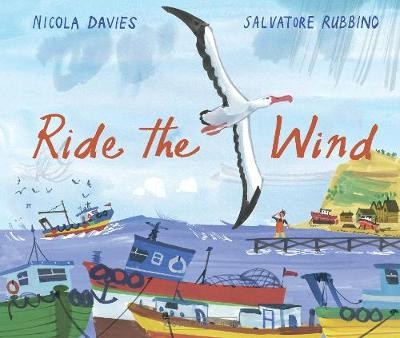
Nicola's book Ride the Wind, illustrated by Salvatore Rubbino and published by Walker Books, features in this year's EmpathyLab Primary Read for Empathy collection. The empathy books are specially selected by an expert panel because they have a specific empathy-building job, like helping children develop new perspectives or recognise and name emotions. Ride the Wind explores the negative impact that the fishing industry has on the albatross - 17 species of which are now threatened with extinction.
Nicola tells us more.
These days, when people ask me what I do, I say I write about the relationship between humans and the natural world. Which makes it sound as if I write books about people lying under trees letting blossoms fall on their faces, or walking bare-foot through the morning dew. But much of what I write about is the negative relationships that we, as a species, now have with nature. Everything about our current predicaments of ecological crisis and global pandemic can be traced back to our broken and dysfunctional relationship with nature, our profound loss of empathy for the other inhabitants of our planet.
My aim in writing Ride the Wind was the explore one of those negative relationships; the one the fishing industry has with sea birds, in particular, albatrosses. Much of the fish that ends up on our plates, is caught by long line fishing, where lines sometimes tens of miles long, strung with thousands of individually baited hooks are set out and hauled in across the oceans. Sea birds try to feed on the bait, get hooked and are drowned by the million. Of the 22 species of albatross - the largest and most magnificent of all seabirds - 17 are threatened with extinction due to long line fishing. Conservation organisations have worked successfully with big commercial fishing operations to find ways in which to prevent this happening. But many of the fishers involved in long lining are small family affairs, with few resources to devote to thinking about saving seabirds.
Small-scale long line fishers off the coast of Chile, where I decided to set my story, are not evil money-grabbing exploiters. They are families with few choices, as much victims of a global culture lacking in empathy as the albatrosses drowned on their hooks. Many South and Central American families have family members who, like albatrosses, travel far to be able to provide for their loved ones. In my story the mother of the family has done just that, and died far from home. In an effort to shut off his grief and carry on, the father, Tomas, treats his son Javier coldly. But when an albatross is caught on one of their lines, Javier sees in the bird another mother, like his own, in trouble far from home. Through Javier’s compassion for the bird, Tomas at last sees his failure to support his grieving son and the shroud of frozen emotion is cracked open.
The fate of the albatross in my story is changed by a boy who sees a bird as not simply an object getting in the way, but as another living being, with loving relationships, like his own. Through his eyes, his father can perhaps begin to see things differently too and take more care over how he sets his fishing lines. But just as albatrosses are dependent on roaming many millions of miles of ocean, so fishers like Tomas are dependent on the wider world of global economics. What Tomas needs to stop him accidentally catching sea birds and contributing to their extinction is a more compassionate world, where those with the fewest resources are not driven to make poor choices that damage the planet and, ultimately all her inhabitants.
Empathy for me means learning to see all the connections. Our survival and the health of our ravishing and precious planet depends on our seeing the net of connection that joins all life, and treating each of its strands with love and respect.
Ride the Wind is available now.
Find out more about Read for Empathy and this year's primary collection here.
Follow Nicola on Twitter @nicolakidsbooks
- hello@peters.co.uk
- 0121 666 6646
- Send a message
- Meet the team
- Peters Ltd
- 120 Bromsgrove Street
- Birmingham
- B5 6RJ