GO
Sorry, but you already have a basket with that name. Please use something else.
Are you sure you wish to delete this basket?()
This action cannot be undone.
Sorry, something went wrong
Please report the problem here.
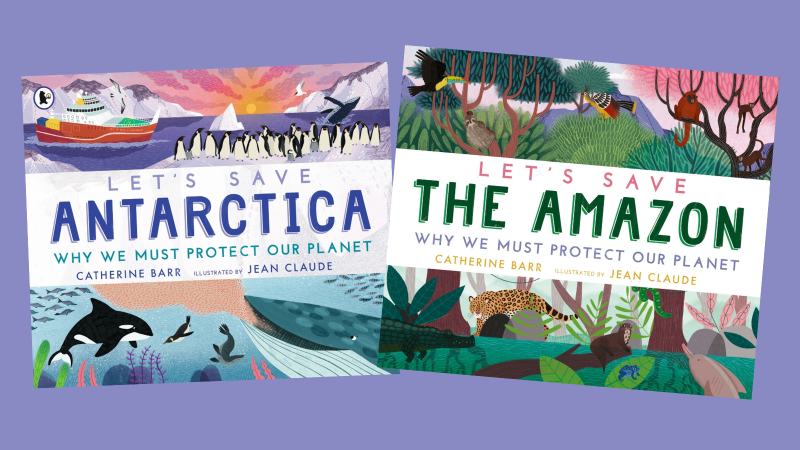
Let’s Save Antarctica and Let’s Save the Amazon by Catherine Barr
April 19th 2022
Author Catherine Barr writes hoping to encourage children to get involved in protecting our natural world with primary geography curriculum books. She studied ecology before working with Greenpeace for many years on wildlife issues, focusing on sea turtles and other endangered species. She has also been an editor for the National History Museum in London, and has worked with the Body Shop, Amnesty and the New Economics Foundation on communications for social and environmental change.
In the lead up to Earth Day on 22nd April, Catherine discusses her Let's Save school picture book series telling the stories of iconic landscapes in the context of climate change, and how they can be used with young readers.
Launched with a focus on Antarctica and the Amazon, this school picture book series tells the stories of iconic landscapes in the context of climate change. With vibrant illustrations by Jean Claude, the wildlife and people who depend on these extraordinary ecosystems are brought to life. Children will be able to celebrate the diversity and wonder of each ecosystem while discovering the roles that the Amazon and Antarctica (and, coming soon, the Great Barrier Reef and mighty Okavango Delta) play in the health of our planet.
At the beginning of each book, gentle introductions help explain to children the connections between all living things. “When one animal or plant moves or disappears from its habitat, the lives of other species that depend on it change too. Climate change is upsetting the balance of nature threatening the most amazing places on Earth. But you can help and together we can protect our planet.”
Scientists at the British Antarctic Survey, Oxford University, the Sustainable Amazon Network and Greenpeace have all advised on the stories of Antarctica and the Amazon. Working with these experts in the field and building networks of interesting people around the globe are some of the joys as a non-fiction author. I welcome the challenge of weaving complex science into a simple non-fiction narrative for young readers, helping them understand the essence of global environment stories. I learned so much in researching and writing the Let’s Save series – it’s a journey I am excited to share.
From “flying rivers” to indigenous wisdom and plumes of Saharan dust, Let’s Save the Amazon explores the greatest rainforest on Earth in a changing global climate. In Let’s Save Antarctica, dinosaur bones, penguin poo, ancient gas bubbles and even life on Mars play a part in the climate story on this frozen continent. I hope the colourful details of Jean Claude incredible illustrations spark children’s fascination with nature – and prompt questions about the role of these ecosystems in a “Code Red” planet.
This series encourages a sense of wonder and discovery that links modern science and indigenous knowledge. The reasons to save these “amazing places” for wildlife as well as people locally and globally are explored within the overarching context of climate change.
In each of the books for curriculum learning, we highlight simple, practical changes that children can make in their everyday lives to help protect our planet. But most importantly for the young readers who explore these books, I hope they will want to know more and enthusiastically share the stories they discover – in classrooms, playgrounds, libraries, over the kitchen table or at bedtime. A simple question inspired by a glorious illustration is a great first step on the path to becoming an eco-warrior, however quiet or loud.
Let's Save the Amazon and Let's Save Antarctica are out now.
Follow Catherine on Twitter @catherine_barr
- hello@peters.co.uk
- 0121 666 6646
- Send a message
- Meet the team
- Peters Ltd
- 120 Bromsgrove Street
- Birmingham
- B5 6RJ