GO
Sorry, but you already have a basket with that name. Please use something else.
Are you sure you wish to delete this basket?()
This action cannot be undone.
Sorry, something went wrong
Please report the problem here.
How to engage boy readers by Tom Mitchell

July 9th 2021
As a parent to two young boys, a secondary school English teacher, and a writer of children’s fiction, I’m always exhausted. You’d think that I’d also be perfectly positioned to suggest how best to get boys to read. But, and here’s the thing, I’m not. Why? Because I don’t encourage boys to read, well, certainly not as distinct from encouraging girls.
Often you hear that getting boys to read non-fiction is a good gateway, as non-fiction might encourage them to move onto fiction. I’ve never been convinced by this logic. Watching the latest Marvel movie doesn’t necessarily create fans of art house cinema. Another widespread approach is suggesting ‘boy-friendly’ books. I’ve certainly been guilty of this - both with my sons and the boys I teach. And, sometimes, it has worked. Other times, however, it’s only further convinced boys that reading is not for them, that it’s something only girls, and English teachers, do.
That’s not to say that I don’t notice differences between the reading of girls and boys. Obviously, all this is anecdotal but Year 7 girls seem more emotionally mature than Year 7 boys. To some degree, this is true throughout the school years. Clearly, this relates to reading – some books are more demanding of our empathetic skills than others. Fiction is an exercise in empathy, after all, so, perhaps, that’s why girls are traditionally considered more able and more interested when it comes to reading novels.
A better approach to promoting reading is to focus on the individual. This might seem self-evident, but gender stereotypes can be reenforced by well-meaning teachers recommending non-fiction to reluctant boy readers, whilst handing out Pride and Prejudice to the girls. Many teachers, and parents too, end up taking this blanket approach due to a lack of knowledge of MG or YA fiction. It’s easy to recommend an action-packed spy thriller to a boy because ‘boys like that’, it’s more difficult to tailor a recommendation to an individual.
That’s why bookshops and libraries are so important, run, as they are, by people with the knowledge and expertise to make such exact recommendations. I’m lucky enough to work in a school with a fabulous librarian. And, living in Kent, I’m also close enough to shops like Sevenoaks Bookshop, which has an entire room, and half the space, dedicated to children’s literature.
This doesn’t let parents completely off the hook, though. The most powerful tool in encouraging any child to read is modelling. I learnt to enjoy books through seeing my parents read. My mother, in particular, made going to the library a routine. That she combined these Saturday morning trips with the purchase of a jam doughnuts made them even more enjoyable. And ... think about it ... next time you’re accused of always having your nose in a novel, you can claim you’re engaged in the important work of encouraging children to read. You’ll just have to make sure there’s a child nearby for this to make sense.
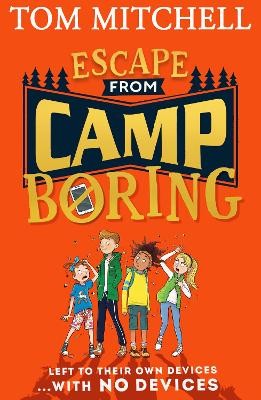
Escape from Camp Boring by Tom Mitchell is out now.
- hello@peters.co.uk
- 0121 666 6646
- Send a message
- Meet the team
- Peters Ltd
- 120 Bromsgrove Street
- Birmingham
- B5 6RJ