GO
Sorry, but you already have a basket with that name. Please use something else.
Are you sure you wish to delete this basket?()
This action cannot be undone.
Sorry, something went wrong
Please report the problem here.
Get your teenage students writing creatively! Logan Macx's top tips
October 15th 2022
 |
About Logan Macx In true spy fashion, Logan Macx is actually the pseudonym of two ghost writers: Edward Docx and Matthew Plampin. Edward is an award-winning novelist and journalist, and Matthew is a historical novelist. Their first joint venture, a high-octane espionage adventure, is aimed at pupils from Year 7 to Year 11 and is a fantastic what-next option for fans of the Alex Rider series by Anthony Horowitz. |
Alongside reading for pleasure, writing for pleasure has a positive effect on the development of students. Edward Docx and Matthew Plampin (collectively known as Logan Macx) know a thing or two about writing. Both successful writers of young adult fiction in their own right, the duo has joined forces for a thrilling new spy series that takes readers from London to Amsterdam. Now, with research showing that children and teenagers who write creatively also read more fluently (and vice versa), they took the time out of their busy schedule to give our readers a quick creative writing masterclass on developmental reading and writing that can be shared with students. Scroll down to find out their five top tips on how to make their own young adult fiction!
The science: how are writing and reading linked?
Scientists have found that developmental reading and writing share cognitive abilities, and when students are reading for pleasure more widely, they produce higher-quality and more creative writing. In the same vein, students who write their own texts or poetry are better able to analyse and understand the books they read, using their knowledge of structure and language to critically evaluate the authors' intentions. The more students read, the richer their vocabulary becomes, and the more confident they feel using varied language in both written and verbal communication. When reading, students may also find a genre that is particularly exciting or inspiring, leading them to create their own imaginary worlds, characters and language. By encouraging students to write as well as read, teachers can encourage a life-long passion for words and books.
Logan Macx's 5 top tips for creative writing
1. Write every day and keep the spell alive! When it comes to creative writing, little and often is better. The more you can keep your story in your conscious mind, the more your subconscious mind can also work on it. Set achievable goals that fit in with your life. Don’t look up at Everest – just aim for the next overnight camp 500 words away. Sometimes you’ll write way more. Sometimes you’ll struggle to slog out 500. That’s enough. Short chapter books are still great even though they’re brief. Small steps.
2. Plan as much as you can so that you have confidence in the story as a whole even if the page in front of you is not working. A young adult fiction journey without a map can be exciting. But it can also be frustrating. You can get lost, bogged down, take wrong turns, lose momentum. You don’t have to know everything – or even most things; but if you have a general sense of where you are heading with some good landmarks to aim at and an awareness of how long each stage might be, then you are less likely to suffer from a loss of heart when you get stuck. You’ll say: “I’m stuck here – at this tricky bit”; rather than “I’m completely stuck and lost and I have no idea if there’s any point in continuing.”
3. Pay attention to the emotional lives of your characters. That’s what makes them real. What attracts us to people in young adult fiction is the same as what attracts us to people in life: a sense that they have a beating heart that feels and an enquiring mind that thinks. Think about how well we know the great characters in fiction - inside and out.
4. Don’t be afraid to entertain random solutions to story problems. Sometimes the way to fix something is by being as imaginatively free as possible. When we were writing this book, we’d often hit plot or character problems. One of us would say – what if they ran into wild animals that were also infected with nano-technology? What if this sequence happened inside an immersive computer game? What if X was really Y’s father? What if Z was 150 years old? Quite often, these suggestions wouldn’t work but sometimes they would lead to a suggestion that did. And the more that you challenge the architecture of your story, the more resilient it becomes.
5. There’s always room for humour. Tension will keep a reader glued to the page but only wit and warmth can make a reader smile. Either is great. Both are irresistible when reading for pleasure.
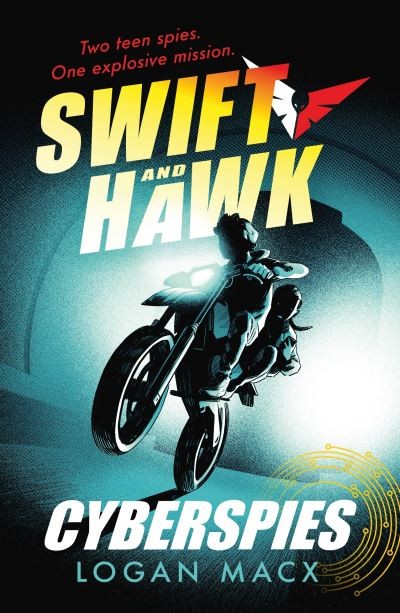 |
CyberspiesWhen their families mysteriously disappear, Swift and Hawk, teen experts in AI and robotics, are recruited by the secretive Moebius Programme to crack an unbreakable code. They are immediately plunged into a life-and-death rescue mission that takes them from hidden tunnels beneath the British Museum to the dangerous docklands of Amsterdam! |
📚 READ NEXT: JACQUELINE WILSON ON WHY LIBRARIES ARE HER FAVOURITE PLACES
- hello@peters.co.uk
- 0121 666 6646
- Send a message
- Meet the team
- Peters Ltd
- 120 Bromsgrove Street
- Birmingham
- B5 6RJ