GO
Sorry, but you already have a basket with that name. Please use something else.
Are you sure you wish to delete this basket?()
This action cannot be undone.
Sorry, something went wrong
Please report the problem here.
Empathy and Self By Anne Booth
February 22nd 2022
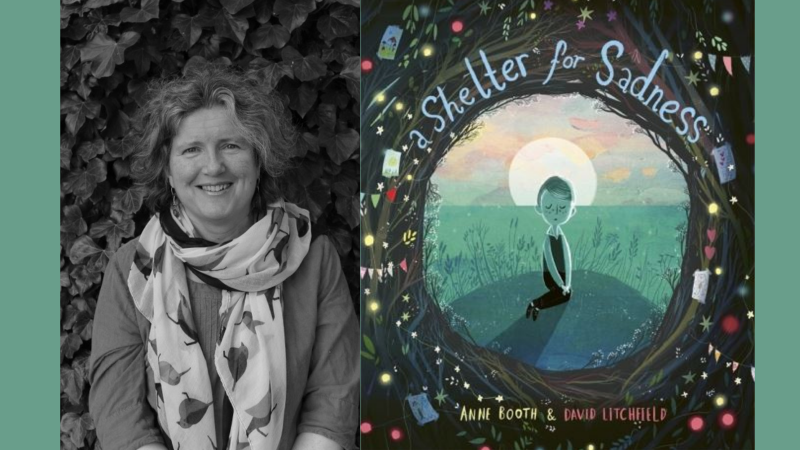
I am really proud and grateful that my and David Litchfield’s book ‘A Shelter for Sadness’ (Templar) has been chosen by The Empathy lab to be part of their 2022 collection.
On the Empathy Lab website, we read that
‘Empathy is our ability to imagine and share someone else’s feelings and perspectives.’
and that Empathy is made up of 3 elements:
- FEELING: where we resonate with other people’s feelings
- THINKING: where we use reason and imagination to work out how someone else feels
- ACTING: where we are inspired to help others, having experienced what they are feeling
https://www.empathylab.uk/research
A society of people caring for others is one we desperately need, and the pandemic has brought home again how vital such empathetic care is for us to survive. It is beautiful to think that ‘A Shelter for Sadness’ could help inspire this in both adults and children.
It is interesting and encouraging to me that ‘A Shelter for Sadness’ has been included in this list, because I actually didn’t write it as a text about caring for others as such, but to encourage others to self-care. I am very glad it has a place in the list because I believe this recognises that self-care is an essential foundation for, component of, and precursor to Empathy.
I’ve often heard that loving others as ourselves presupposes that we DO love ourselves first, and that if we don’t recognise and respect our own existing hurts and sadness, we cannot truly go on to empathise with others. It is important to build a shelter for our sadness, and if we deny or belittle our own sadness, we risk being unable to empathise with sadness in others. Alternatively, we may unhealthily project our own denied feelings on to others, who we then need to ‘help’ in order to deal with our own unresolved issues. Imposing feelings on and ‘helping’ others primarily to make US feel better, is not Empathy either.
I think that Empathy always involves deep respect for ourselves and the other, and a recognition that although we can recognise and ‘resonate with’ others’ feelings, they are still not our feelings, and we are each separate, mysterious individuals, and other people are not to be projected on or pitied.
I hope that my words and David’s beautiful illustrations in ‘A Shelter for Sadness’ can be used as a foundation for developing Empathy. I hope they help children deal with difficult feelings of grief and loss, however small or big the causes, to deal kindly with themselves and to recognise and identify their own sadnesses. I hope this will then help them to not feel overwhelmed when they encounter other people’s sadnesses, so they can recognise, empathise with and help those people they meet who are sad. I am so encouraged when I hear that someone has been helped by our book, and I am also so happy when I read that someone has empathetically given our book to another to help them.
A Shelter for Sadness is out now.
Order the Read for Empathy packs 2022.
- hello@peters.co.uk
- 0121 666 6646
- Send a message
- Meet the team
- Peters Ltd
- 120 Bromsgrove Street
- Birmingham
- B5 6RJ